
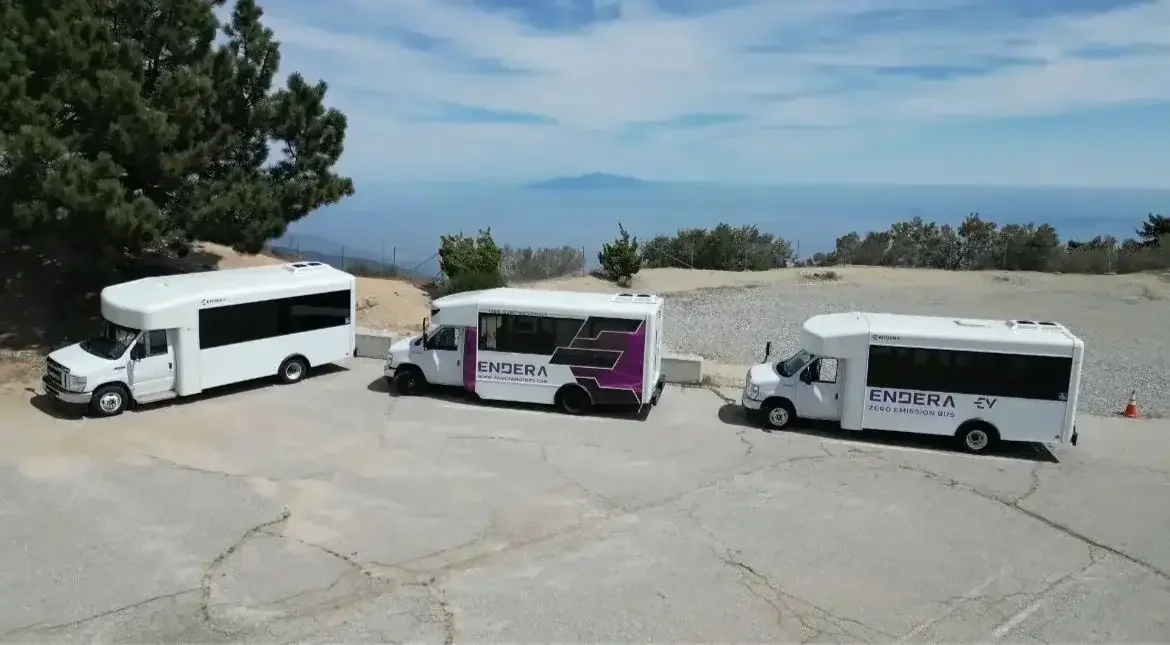
The 2026 B-Series models are in production and available now. For fleet operators looking to replace aging vehicles, expand capacity, or take a first step toward electrification, this is the current lineup to evaluate — four models, 23 to 28 feet, gas and electric options, built on Ford E450 and Chevrolet Express cutaway chassis at Endera's Ottawa, Ohio manufacturing facility.
If you're ready to move quickly, Endera Stock lists in-stock 2026 models available for immediate delivery. If you need a custom build, Endera's sales team can walk you through configuration options and current lead times.
Ready to move on your 2026 fleet update? Contact Endera's sales team today to check availability or start a custom build.
What's New in the 2026 B-Series
Continued Platform Refinement, Same Proven Architecture
The 2026 B-Series builds on the same vertically integrated manufacturing approach that has defined the lineup since Endera's acquisition of its Ottawa facility — both EV system integration and body construction happen under one roof, by one team, against the same engineering standards. What continues to improve is the refinement of that process: tighter tolerances, better software integration between the vehicle and Endera's fleet management platform, and ongoing development of the proprietary EV powertrain. The battery pack remains housed within the structural frame rails, keeping the center of gravity low and protecting high-voltage components within the vehicle's structural core.
2026 Stock Vehicles for Fast Deployment
For operators who can't wait for a custom build, Endera Stock carries ready-to-deliver 2026 models built on the Ford E450 chassis. These units are configured for rapid deployment — meaning you can have a vehicle on your property and in service significantly faster than a custom build timeline allows. For fleet managers replacing a vehicle unexpectedly or expanding mid-year outside the normal procurement cycle, in-stock availability removes one of the most frustrating variables in the purchasing process.
The 2026 B-Series Model Lineup
B3 and B8 — ICE Models for Defined Applications
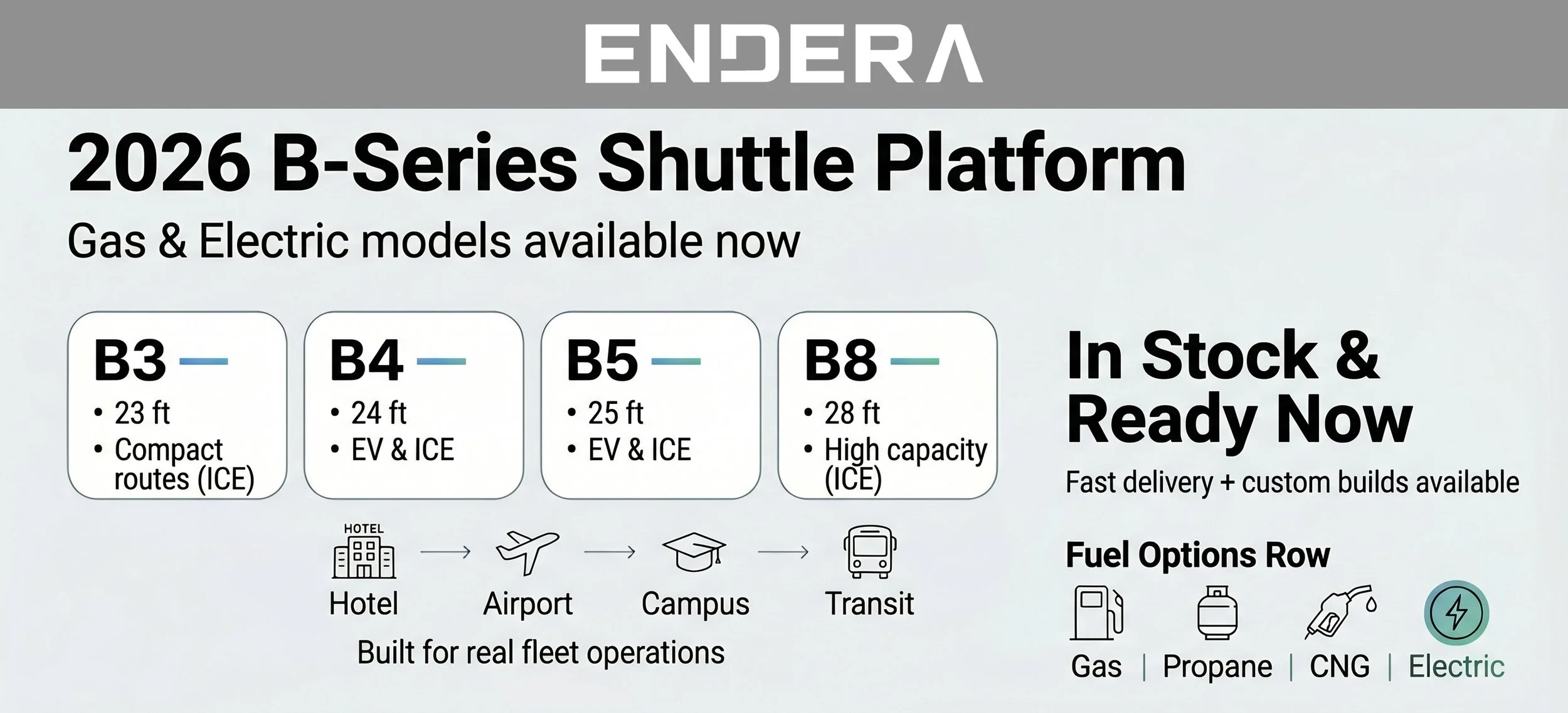
The B3 (23 ft) is the most compact model in the lineup — gasoline, propane, and CNG configurations, built for hotel loops, small campus circulators, and urban pickup operations where maneuverability and lower passenger volume are the priorities. The B8 (28 ft) sits at the other end — a high-capacity ICE model for municipal transit, large group transport, and high-frequency routes where maximum passenger volume is the operational requirement. Both are ICE-only in 2026, built on proven cutaway chassis with broad service network support.
B4 and B5 — The Electric and ICE Workhorses
The B4 (24 ft) and B5 (25 ft) are available in both ICE and full electric configurations — making them the most versatile models in the lineup and the entry point for operators exploring electrification. The B4 holds an Altoona durability test score of 90.1, the highest in its class, providing third-party validation that matters for municipal and institutional procurement. Both EV models run on a 150 kWh battery pack with the Cascadia iM225 motor, DC fast charging standard, and the battery pack integrated within the structural frame rails for stability and crash protection.
| Model | Length | Fuel Options | Primary Applications |
|---|---|---|---|
| B3 | 23 ft | ICE / Propane / CNG | Hotel loops, small campus, urban pickup |
| B4 | 24 ft | ICE & EV | Airport parking, university transit, corporate |
| B5 | 25 ft | ICE & EV | Employee shuttles, off-site connectors |
| B8 | 28 ft | ICE / CNG | High-volume municipal, large group transport |
Choosing Between Gas and Electric in 2026
Where Electric Makes Sense Right Now
The EV case in 2026 is strongest for operators running defined, predictable routes with access to depot charging — airport parking loops, university campus circulators, corporate employee shuttles. These are environments where utilization is high, routes are consistent, and the fuel and maintenance savings compound meaningfully over the vehicle's service life. Operators at San Diego International Airport running Endera's electric fleet have forecasted nearly $20,000 in annual savings per vehicle annually compared to LPG or CNG. Over a fleet of ten vehicles across a 10-year service cycle, that math changes what an EV costs in practice versus what it costs on paper.
Where Gas, Propane, or CNG Still Makes More Sense
Not every operation is set up for electrification yet, and Endera doesn't pretend otherwise. For operators in markets where charging infrastructure is sparse, running longer variable routes, or managing fleets across multiple locations without centralized charging capability, ICE, propane, or CNG configurations remain the practical choice in 2026. CNG in particular makes sense in markets where natural gas infrastructure is already developed — lower fuel costs, cleaner emissions than gasoline, and no charging infrastructure requirement.
The shared B-Series platform means operators can run mixed fuel configurations across the same model family, with consistent parts availability and maintenance procedures regardless of powertrain.
What "New" Means Beyond the Vehicle
Software That Ships With Every Shuttle
Every 2026 B-Series commercial shuttle comes available with access to Endera's fleet management platform. Endera Dispatch gives fleet managers real-time vehicle tracking, performance analytics, and state-of-charge monitoring for EV fleets. Endera Go is the passenger-facing app — live shuttle location, ETA updates, and occupancy data for riders. Both tools are purpose-built for transportation operators, not adapted from generic logistics software, and both are updated alongside the vehicle lineup rather than treated as afterthought add-ons.
Charging Infrastructure and Grant Support
For operators buying electric in 2026, Endera's platform services include site assessments, charging station procurement, and turnkey installation — handling the infrastructure side of the EV transition alongside the vehicle purchase. On the funding side, Endera's financing and grant advisory team helps operators identify and apply for available programs — including the EPA Clean School Bus Program, HVIP in California, IRS commercial clean vehicle credits, and other federal and state incentives — tapping into more than $20 billion in available EV subsidies. Direct financing and capital leasing options are also available for operators who prefer to preserve capital rather than purchase outright.
True Cost vs. Cash Flow Reality
The Part of the EV Math That Usually Gets Left Out
Electric shuttles are often positioned as the clear financial winner — and over a full lifecycle, that's generally accurate. Lower fuel and maintenance costs do make EVs cheaper to operate over time. But most comparisons stop there, and what actually drives buying decisions is how those savings are distributed across time.
The challenge for most operators isn't total cost — it's cash flow. Electric buses carry significantly higher upfront costs than ICE equivalents, largely due to battery systems and lower production scale at current volumes. That higher capital expense shows up immediately, while the savings accrue slowly across years of operation.
What to Actually Plan For
Financing adds another layer. Lenders often view EVs as higher-risk assets, which can lead to tighter terms and higher monthly payments — making early-year cash flow harder to manage even when long-term ROI is positive. Incentives help, but timing matters: the IRS commercial clean vehicle credit and programs like HVIP can reduce total cost meaningfully, but they don't always offset the upfront purchase at the moment of transaction — that gap has to be bridged operationally.
Battery lifecycle is a longer-term consideration too: replacement costs, while improving as the industry matures, remain a mid-cycle planning item that operators should factor into their ownership model. EVs are often cheaper over 10 years — but more demanding in years one through three. Whether that tradeoff works depends on whether your operation can absorb the upfront financial pressure required to reach the savings. Endera's financing and leasing options are specifically structured to help operators manage that early-year burden while capturing the long-term benefit.
Lead Times and What to Expect in 2026
Custom Builds vs. In-Stock Availability
Procurement demand for new commercial shuttles typically peaks in late winter and spring as operators prepare for the upcoming season — which means lead times for custom builds lengthen during that window. A 2023 survey of transportation providers found that nearly half of fleets experienced moderate or severe disruptions due to delayed OEM production timelines, with wait times for new vehicles extending 6–12 months in some cases.
Endera's domestic manufacturing and Ohio-sourced supply chain partially insulates buyers from the worst of those delays, but custom configurations still require production time that in-stock units don't.
Planning Your 2026 Purchase Timeline
For operators with flexibility, engaging Endera's team early in the year gives the most configuration options and the most predictable delivery window. For operators with urgent needs, Endera Stock is the fastest path to a 2026 vehicle — units listed there are built and ready to ship. Either way, the earlier the conversation starts, the more options remain on the table.
2026 Is the Year to Move
Whether you're replacing a vehicle that's reached the end of its service life, adding capacity to a growing fleet, or taking your first step toward electrification, the 2026 B-Series lineup has the configuration to fit the operation. In-stock units are ready now. Custom builds are open for order. And Endera's team is available to walk through whichever path fits your timeline and budget.
Your next fleet upgrade is already built. Connect with an Endera specialist today to explore 2026 B-Series availability and find the right configuration for your fleet.
FAQs
What 2026 B-Series models are currently available?
All four B-Series models — the B3, B4, B5, and B8 — are available in 2026 configurations. Ready-to-deliver units are listed at Endera Stock. Custom builds can be discussed with Endera's sales team.
Which 2026 models are available in electric?
The B4 (24 ft) and B5 (25 ft) are available in full electric configurations in 2026, powered by a 150 kWh battery pack and Cascadia iM225 motor with DC fast charging standard. The B3 and B8 are ICE-only.
How quickly can I receive a 2026 B-Series shuttle?
In-stock units at Endera Stock are available for rapid deployment. Custom builds have longer lead times depending on configuration and production schedule — contact Endera's team for current timelines.
What chassis options are available on 2026 models?
2026 B-Series models are available on Ford E450 and Chevrolet Express cutaway chassis. In-stock units are currently built on the Ford E450; custom builds can be configured on either platform.
Does Endera offer financing for 2026 purchases?
Yes. Direct financing, capital leasing, and grant advisory services are available through Endera's financing team. The team also assists with identifying and applying for federal and state EV incentive programs.
Are 2026 Endera shuttles Buy America compliant?
Yes. With approximately 65% of components sourced from within Ohio, Endera's manufacturing model supports Buy America compliance for federally funded procurement contracts.
Where are 2026 B-Series shuttles manufactured?
All 2026 B-Series models are built at Endera's Ottawa, Ohio facility — a 250,000-square-foot plant where EV integration and body construction happen under one roof.