
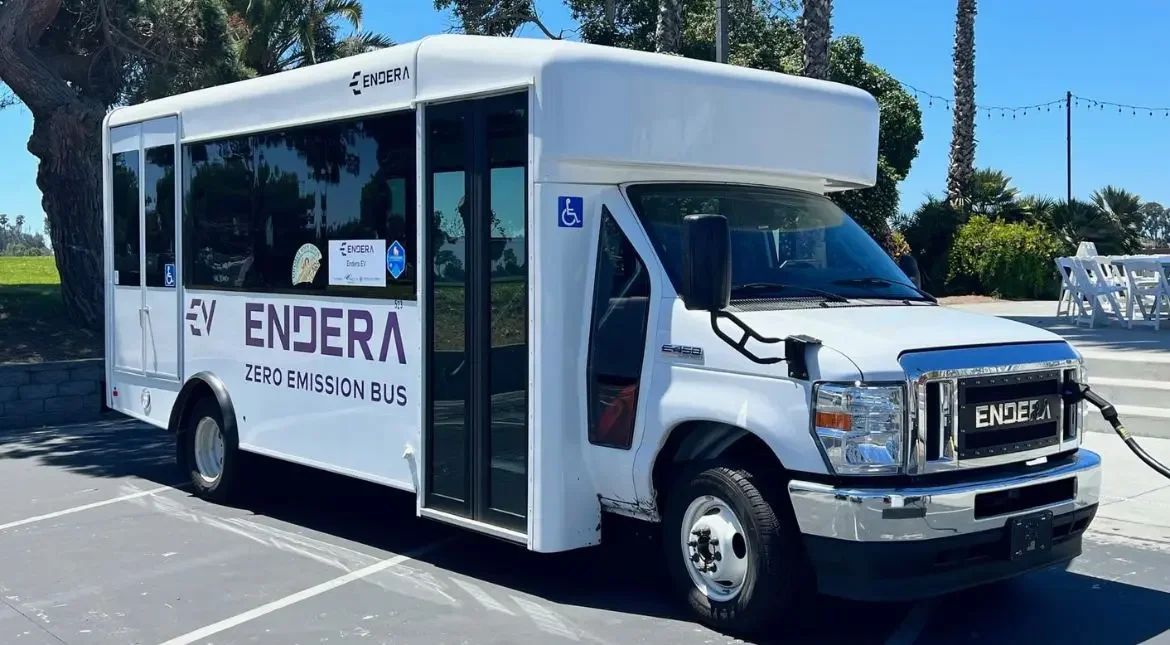
Iowa doesn't have a state EV mandate, a statewide shuttle electrification push, or the kind of layered incentive programs you find in Washington or California. What it does have is a practical fleet operator base — universities, hospitals, hotels, agricultural operations, and municipal transit systems — that needs reliable, cost-effective commercial shuttles across a wide range of route types and weather conditions. For those operators, the vehicle decision is less about compliance and more about finding the right fit for the route.
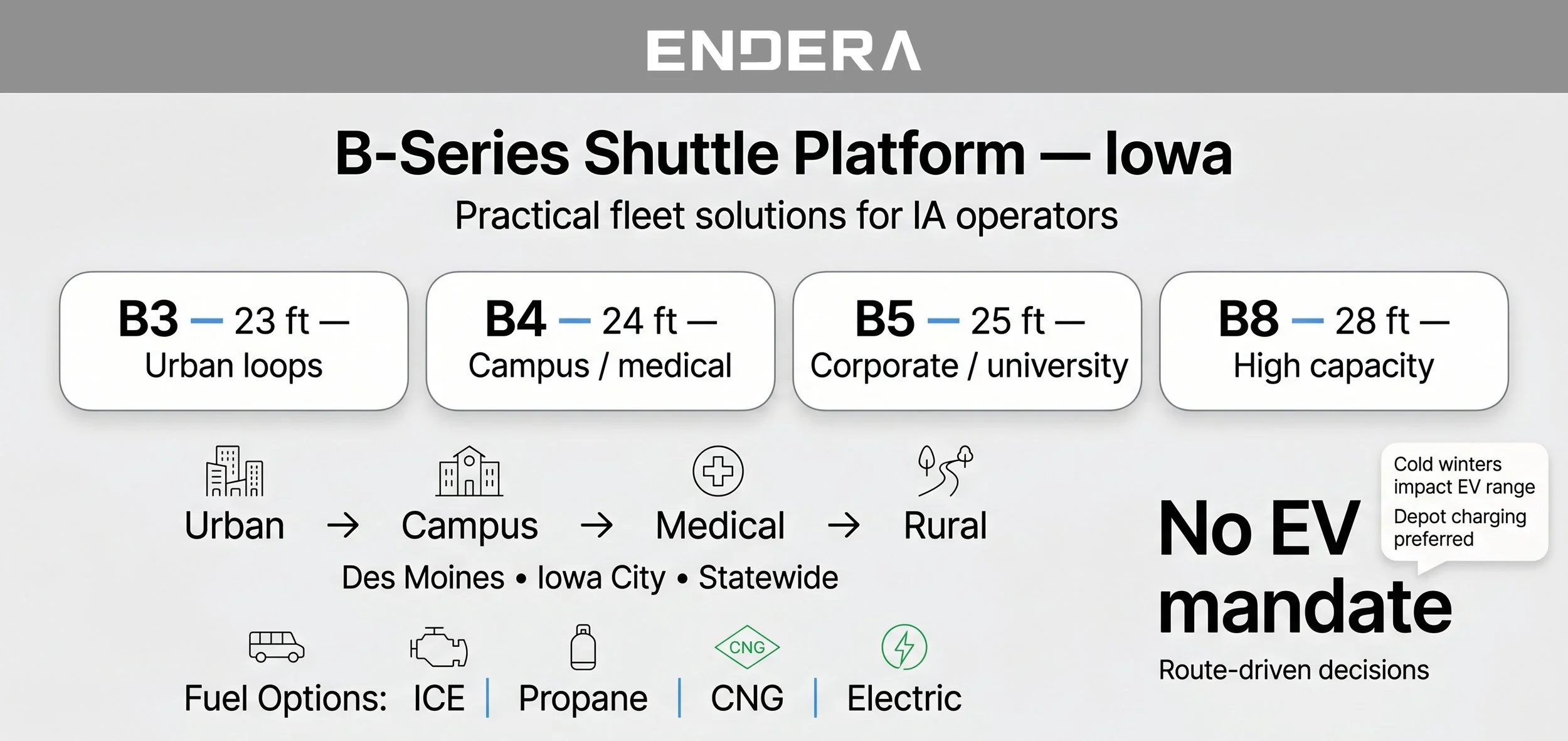
Endera's B-Series — the B3, B4, B5, and B8, ranging from 23 to 28 feet — covers that full range. ICE, propane, CNG, and electric configurations are available, built on Ford E450 and Chevrolet Express cutaway chassis, manufactured at Endera's Ottawa, Ohio facility with a domestic supply chain that supports federally funded procurement. For Iowa operators, the multi-fuel flexibility isn't a hedge — it's the point.
Ready to find the right fit for your routes? Talk to an Endera specialist today to compare configurations and check current availability.
Iowa's Fleet Landscape: What Actually Shapes the Decision
A Practical Market Without Mandate Pressure
Iowa has no statewide electrification requirement for commercial vehicle fleets as of 2026. There are no state-level EV purchase rebates either — Iowa's incentive landscape is largely utility-driven, with programs from MidAmerican Energy and Black Hills Energy focused on charging infrastructure rather than vehicle purchase. Federal programs — the IRS commercial clean vehicle credit and the 30C charging equipment tax credit — remain available and meaningful, but the state isn't adding layers on top. For Iowa fleet operators, that means the EV decision rests squarely on operational fit and long-term financial planning rather than policy-driven urgency.
Iowa's Geography and Climate Create Real Operating Demands
Iowa's winters are a genuine EV consideration. Cold temperatures reduce battery performance and increase heating load, compressing effective range in ways that matter for operators running longer or less predictable routes. Iowa's geography also means rural routes cover more ground than urban equivalents — a reality that affects both range planning and charging infrastructure access. Des Moines, Cedar Rapids, Iowa City, and Davenport have better charging coverage than rural central and western Iowa, where Iowa's NEVI buildout is still progressing along interstate corridors before reaching local and community locations.
The B-Series Lineup for Iowa Operations
Four Models for Iowa's Range of Applications
The B3 (23 ft) is the compact ICE model — well suited for hotel loops in Des Moines, small campus circulators, and urban pickup operations where maneuverability matters more than capacity. The B4 (24 ft) and B5 (25 ft) step up in capacity and unlock both ICE and full electric configurations — the right fit for university transit at the University of Iowa or Iowa State, medical center shuttles, and higher-frequency corporate routes. The B8 (28 ft) handles high-volume routes where passenger capacity is the operational priority.
Chassis Coverage Across Iowa's Markets
All B-Series models are available on Ford E450 or Chevrolet Express cutaway chassis — platforms with broad dealer and service network coverage across Iowa, including in smaller markets well outside the Des Moines and Cedar Rapids metro areas. For Iowa operators in communities where a specialized bus service center isn't nearby, that chassis familiarity means your local Ford or GM commercial dealer can support the underlying platform, reducing downtime risk when service is needed.
Fleet Decision Framework: Iowa Routes and the Right Configuration
Matching the Vehicle to What Iowa Routes Actually Demand
| Use Case | Recommended Model | Fuel Type | Why |
|---|---|---|---|
| Hotel / resort loop (Des Moines, Quad Cities) | B3 / B4 | ICE or Propane | Lower volume, cost-efficient, flexible fuel |
| University transit (UI, ISU, UNI) | B4 / B5 | EV or CNG | Defined routes, campus infrastructure potential |
| Medical center / hospital shuttle | B4 / B5 | ICE or EV | Reliability priority, predictable schedules |
| Corporate / agricultural campus | B5 | ICE or EV | Higher capacity, defined route cycles |
| High-volume municipal / airport | B8 | ICE / CNG | Maximum capacity, longer route coverage |
For Iowa university operators — particularly at the University of Iowa in Iowa City, which already has EV charging infrastructure on campus — the electric B4 and B5 are operationally viable and financially attractive when federal credits are applied. For operators in rural Iowa or those running longer, less predictable routes, CNG and propane remain the practical choice while charging infrastructure continues to develop statewide.
Cold Weather and EV Performance in Iowa
What Iowa Winters Actually Do to Range
Iowa’s winters significantly impact EV performance. Cold temperatures increase energy use due to heating demands and reduced battery efficiency, lowering real-world range—especially on winter routes. EVs are still viable, but they require careful route planning and charging strategies that account for seasonal changes rather than relying on year-round specs.
Where It Affects Deployment Planning
Short, predictable Iowa routes — campus loops, medical center circulars, urban hotel shuttles — absorb that winter range reduction without significant operational disruption, particularly with depot charging overnight. Longer rural routes in western or northern Iowa require more conservative planning and may be better served by CNG or propane in the near term. Endera Dispatch provides real-time state-of-charge monitoring that helps Iowa operators manage these seasonal variables during operation — catching issues before they affect service rather than after a bus runs short mid-route.
Charging Reliability vs. Coverage Reality in Iowa
The Gap Between Map and Operations
Iowa’s EV charging network looks solid on paper, with 600+ outlets and growing fast-charger coverage. But availability matters more than totals. Chargers are mostly concentrated along highways due to NEVI funding, which supports long-distance travel but leaves gaps locally. Cities like Des Moines and Iowa City are well covered, while rural areas have more limited and less reliable access.
Reliability Is the Variable Operators Underestimate
Charger reliability adds real challenges. Even with a 97% uptime target, stations can be offline, occupied, or malfunctioning. For fleets, a failed charge can disrupt schedules and require backup vehicles. In Iowa, EV success depends on reliable, well-placed charging for daily routes—so on-site depot charging is key, with public chargers used as a backup.
Incentives for Iowa Fleet Operators
Federal Programs Are the Primary Lever
With no state-level EV purchase incentive, Iowa fleet operators considering electrification should focus on federal programs. The IRS commercial clean vehicle credit applies to qualifying commercial EV purchases and can meaningfully offset the upfront cost difference between ICE and electric configurations.
For operators installing depot charging, the 30C tax credit covers up to 30% of charging equipment cost, up to $100,000 per port, through June 2026. Iowa utilities including MidAmerican Energy offer time-of-use rate programs that reduce the per-kWh cost of overnight fleet charging — a practical operating cost advantage that compounds across a full fleet's annual mileage.
True Cost vs. Cash Flow for Iowa Operators
Electric shuttles carry higher upfront costs than ICE equivalents, and Iowa's thinner incentive stack means that gap closes more slowly than in states like Washington. The savings accrue over time through lower fuel and maintenance costs — the Electric School Bus Initiative documents that electricity is cheaper and more price-stable than diesel — but the early-year cash flow pressure is real.
Endera's financing and leasing options are structured to help operators manage that pressure, with direct financing, capital leasing, and grant coordination available depending on the operator's budget structure and timeline.
Manufactured in Ohio, Delivered to Iowa
Domestic Supply Chain, Predictable Lead Times
Every B-Series shuttle is manufactured at Endera's 250,000-square-foot Ottawa, Ohio facility, with approximately 65% of components sourced within Ohio. That domestic manufacturing supports compliance with Buy America standards for Iowa operators accessing federal transit funding — including university transit systems, municipal operators, and medical center fleets that may draw on FTA or other federal programs.
Lead times are more predictable than vehicles built from international supply chains, which matters for Iowa operators planning deployments around academic calendars or fiscal year budgets.
Fleet Software That Travels With the Vehicle
Every Endera commercial shuttle comes available with Endera Dispatch for real-time vehicle tracking, route performance data, and EV state-of-charge monitoring, alongside Endera Go for passenger-facing shuttle location and ETA updates. For Iowa operators managing multiple vehicles across a campus or medical campus, that fleet visibility reduces operational guesswork without adding staff overhead.
The Right Shuttle for Iowa, Built Without Compromise
Iowa fleet operators don't need a mandate to make a good fleet decision — they need a vehicle that fits the route, handles the climate, and comes from a manufacturer that stays accountable after delivery. The B-Series covers the full range of Iowa operating conditions across four models, four fuel types, and two chassis options, backed by fleet software and financing support that make the purchase and the operation easier to manage.
Your routes have specific demands. Your shuttle should meet them. Talk to an Endera specialist today to find the right B-Series configuration for your Iowa fleet.
FAQs
Which B-Series models are available for Iowa operators?
All four models — B3 (23 ft), B4 (24 ft), B5 (25 ft), and B8 (28 ft) — are available in Iowa in ICE, propane, CNG, and electric configurations depending on model. Contact Endera's sales team for current availability and lead times.
Does Iowa have state EV incentives for fleet purchases?
Iowa has no state-level EV purchase rebates as of 2026. Federal programs — including the IRS commercial clean vehicle credit and 30C charging tax credit — remain available and are the primary financial tools for Iowa operators considering electrification.
Are electric shuttles practical in Iowa's winters?
Yes, with route-level planning. Cold temperatures reduce effective EV range due to heating load and battery performance. Short, predictable routes absorb that reduction well with overnight depot charging. Longer rural routes may be better served by CNG or propane in the near term. Endera Dispatch provides real-time state-of-charge monitoring to support seasonal planning.
What chassis options are available in Iowa?
All B-Series models are available on Ford E450 and Chevrolet Express cutaway chassis, both broadly serviced through dealer networks across Iowa including in smaller markets.
Does Endera help Iowa operators access federal EV incentives?
Yes. Endera's financing and grant advisory team assists Iowa operators in identifying and applying for federal programs including the IRS commercial clean vehicle credit and 30C charging credit, as well as structuring purchases through direct financing or capital leasing.
Do Endera shuttles comply with Buy America requirements?
Yes. With approximately 65% of components sourced domestically, Endera's manufacturing supports Buy America compliance for federally funded Iowa procurement contracts.
Can I get an in-stock 2026 shuttle for fast delivery in Iowa?
Yes. Endera Stock lists ready-to-deliver 2026 models available for rapid deployment without a custom build lead time.